

Shoujin Zhou & Stephan Rothlin
Abstract
Pope Leo XIV's 2026 encyclical Magnifica Humanitas offers a profound diagnosis of the existential risks posed by Artificial Intelligence (AI), calling for a return to "Integral Humanism." This paper responds to the Pontiff's appeal by articulating a Confucian response. We argue that Confucianism does not merely echo the Encyclical's concerns but offers a distinct metaphysical and ethical framework to address the "technocratic paradigm." By reinterpreting the relationship between Ren (benevolence) and Zhi (wisdom), and proposing a governance model based on the "Common Good" (Gong Shan) and "Harmony" (He), this paper suggests that Confucian wisdom can help "disarm" the algorithms and ensure AI serves the flourishing of the human family.
1. Introduction: The New Rerum Novarum for the Digital Age
In 2026, Pope Leo XIV promulgated the Encyclical Letter Magnifica Humanitas, a document widely regarded as the Rerum Novarum of the digital age. Just as Leo XIII addressed the exploitation of the Industrial Revolution, Leo XIV addresses the "new things" (res novae) of the algorithmic era. The Encyclical warns that without a moral compass, AI risks becoming a "Tower of Babel"—a monument to human pride that leads to confusion and dehumanization (Leo XIV, 2026, n. 7).
The core thesis of Magnifica Humanitas is that technology must remain subordinate to the "grandeur of the human person" (Leo XIV, 2026, n. 90). The Pope proposes "Integral Humanism" as the antidote to the "technocratic paradigm," urging a shift from efficiency to solidarity, from data extraction to the common good.
This paper accepts the Pope's invitation to dialogue. We posit that Confucianism, with its millennia of reflection on the relationship between humanity (Ren) and technology/culture (Wen), offers a robust philosophical partner in this endeavor. We aim to move beyond a superficial comparison to a deep structural resonance, demonstrating how Confucian ethics can operationalize the Pope's vision of a "Civilization of Love" in the context of AI governance.
2. The Fourfold Crisis: A Confucian Diagnosis
Magnifica Humanitas diagnoses four specific crises embedded in the rise of AI: human dignity, social justice, truth, and ecology. A Confucian reading deepens this diagnosis by locating the root cause in the separation of "The Way" (Dao) from technical skill.
2.1 The Crisis of Dignity: From "Relational Self" to Data Point
The Encyclical laments that AI reduces individuals to data points, simulating empathy without moral conscience (Leo XIV, 2026, n. 1). This aligns with the Confucian fear of becoming a "vessel" (Qi)—a mere tool—rather than a "Noble Person" (Junzi).
In Confucian anthropology, the self is not an isolated atom but a "relational node." As the Analects states, "To be human (Ren) is to love others" (12.22). Dignity arises from our capacity to cultivate relationships. AI, when it replaces human interaction with algorithmic mediation, attacks the very root of Confucian personhood. It creates a "disembodied" existence that contradicts the Confucian insistence that moral cultivation (Xiushen) must happen through concrete, embodied rituals (Li) in the real world.
2.2 Social Justice: The Confucian Critique of "Data Colonialism"
Leo XIV condemns "data colonialism," where tech giants exploit the vulnerable (Leo XIV, 2026, n. 5). This resonates with the Mencian critique of rulers who "lead beasts to devour men" by prioritizing profit over people's livelihood (Mencius, 1A:4).
Confucianism argues that the economy must be embedded in ethics. The Great Learning teaches that a state should not prioritize wealth but should prioritize righteousness (Yi). "If the ruler sets his heart on benevolence, the people will respond with benevolence" (Mencius, 1A:1). The current AI model, which extracts value from the many to enrich the few, violates the Confucian principle of "sharing wealth with the people" (Yu Min Tong Zhi).
2.3 Truth and the "Rectification of Names"
The Encyclical warns of deepfakes and the erosion of truth (Leo XIV, 2026, n. 132). Confucianism addresses this through the doctrine of the "Rectification of Names" (Zheng Ming). Confucius argued, "If names are not correct, language is not in accordance with the truth of things" (Analects, 13.3).
In the age of AI, "names" (labels, data categories, algorithmic identities) are often distorted. When an algorithm labels a human being as a "risk factor" or a "consumer profile" rather than a person, it violates Zheng Ming. A Confucian response demands that AI systems be designed to reflect the reality of human dignity, not to obscure it for the sake of manipulation.
2.4 Ecology: The Unity of Heaven and Humanity
Finally, the Pope highlights the material cost of the digital world (Leo XIV, 2026, n. 101). This echoes the Confucian concept of the "Unity of Heaven and Humanity" (Tian Ren He Yi). In this view, humanity is not the conqueror of nature but its partner. The massive energy consumption of data centers represents a failure of "filial piety" toward the cosmos, disrupting the harmony that sustains life.
3. The Confucian Response: Re-grounding AI in Virtue
To answer the Pope's call for "Integral Humanism," we propose a Confucian framework centered on the dynamic balance between Ren (Benevolence) and Zhi (Wisdom/Technical Intelligence).
3.1 The "Ren-Zhi" Dialectic: Subordinating Instrumental Reason
A central theme in Magnifica Humanitas is the danger of intelligence without wisdom. The Encyclical notes that "intelligence, when absolutized, overshadows... affection, the will, commitment and relationships" (Leo XIV, 2026, n. 113).
Confucianism provides the precise vocabulary for this distinction. Zhi (often translated as wisdom, but here implying technical or cognitive intelligence) is the capacity to know and to act efficiently. Ren is the moral heart, the feeling of care for others.
Confucius warned: "If a man has wisdom (Zhi) sufficient to attain a goal, but lacks benevolence (Ren) to hold onto it, he will lose it" (Analects, 15.34).
- Zhi without Ren: This is the "barbaric growth" of AI—highly efficient but morally blind. It leads to the "Tower of Babel," where technical capability outpaces moral maturity.
- Ren without Zhi: This is impotent moralizing. We need the technical capacity (Zhi) to solve problems like disease and poverty.
The Synthesis: The Confucian response is that AI represents the ultimate extension of Zhi. To safeguard humanity, we must ensure that Ren acts as the "steering wheel" for the "engine" of AI. This aligns perfectly with the Pope's assertion that "human intelligence... must guide technical innovations" (Leo XIV, 2026, n. 97).
3.2 Defining the Confucian "Common Good" (Gong Shan)
The Encyclical places the "Common Good" at the center of AI governance (Leo XIV, 2026, n. 59). In Confucianism, the Common Good is not merely the sum of individual preferences (utilitarianism) but an organic state of "Great Harmony" (Datong).
We define the Confucian Common Good through a tripartite structure:
- The Commonality of Virtue: Goodness is inherently relational. As Mencius argued, one cannot be truly virtuous in isolation. The "good" of an AI system must be measured by how it improves the moral quality of relationships (e.g., between doctor and patient, teacher and student), not just by speed or profit.
- The Commonality of Well-being: The Book of Rites describes the Datong society: "The way is practiced, and the world is shared by all... The aged find their end, the strong their use, and the young their growth" (Liji, Liyun). This is a direct parallel to the Pope's vision of an economy that "values dignity" (Leo XIV, 2026, n. 157).
- The Transformation from Virtue to Well-being: In Confucian thought, moral order leads to material flourishing. If AI is governed by Ren (benevolence), the result will naturally be Datong (universal well-being).
3.3 "Disarming" the Algorithm through Li (Ritual/Propriety)
The Pope calls for "disarming" AI to free it from the mentality of armed competition (Leo XIV, 2026, n. 110). Confucianism offers Li (Ritual/Propriety) as the mechanism for this disarmament.
Li is often misunderstood as mere ceremony. In reality, Li is the "grammar of social interaction" that prevents conflict. It creates "temporal autonomy"—spaces of rest and reverence (like the Sabbath) where the logic of efficiency is suspended.
Application to AI: We need "Digital Li." These are protocols and norms that prioritize human dignity over algorithmic optimization. For example, a "Right to Disconnect" is a form of Li that protects the family from the intrusion of work algorithms. Li acts as a "firewall" against the "tyranny of real-time," preserving the silence necessary for the "rectification of the heart" (Zheng Xin).
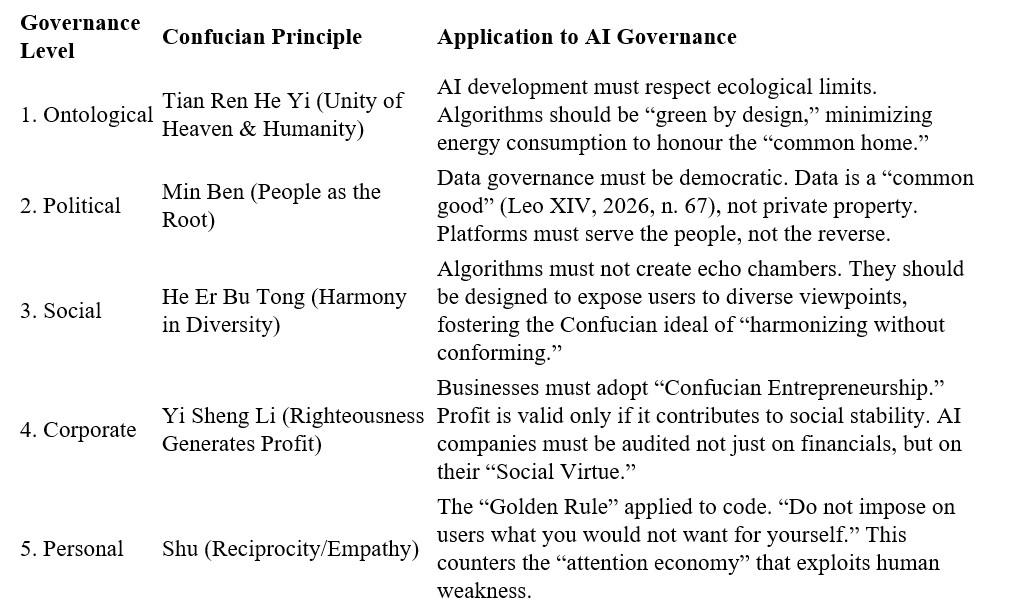
4. Toward a "Civilization of Love": A Five-Tier Governance Framework
To move from theory to practice, we propose a Confucian-inspired governance framework that operationalizes the principles of Magnifica Humanitas.
4.1 The Role of the "Junzi" (Noble Person) in Tech
The Encyclical calls for leaders with moral courage. Confucianism emphasizes the role of the Junzi (Noble Person). In the tech industry, this means cultivating "Tech-JUNZI"—engineers and executives who view their work as a moral vocation, not just a job. They are the ones who will "rebuild the walls of Jerusalem" (Leo XIV, 2026, n. 8) by coding ethical constraints into the very architecture of AI.
4.2 Education: The Root of the Solution
Both the Pope and Confucius agree that the solution lies in education. Magnifica Humanitas calls for an "educational alliance" (Leo XIV, 2026, n. 139). Confucianism adds that this education must be holistic—cultivating the "Six Arts" (ritual, music, archery, charioteering, calligraphy, mathematics).
Modern AI education should not just teach coding (Mathematics) but must heavily emphasize Ethics and Philosophy (Ritual/Music). We need to produce "whole persons" who can judge whether an algorithm is beautiful (good for society) as well as efficient.
5. Conclusion: Rebuilding Jerusalem Together
Pope Leo XIV ends his Encyclical with the image of Nehemiah rebuilding the walls of Jerusalem, stone by stone (Leo XIV, 2026, n. 241). This is a call to action.
The Confucian response to Magnifica Humanitas is one of profound agreement and active cooperation. We agree that the "technocratic paradigm" is a new Tower of Babel. We agree that "Integral Humanism" is the only path forward.
By integrating the Confucian virtues of Ren (Benevolence), Yi (Righteousness), and Li (Propriety) into the governance of AI, we can help "disarm" the algorithm. We can ensure that the "Common Good" is not just a slogan, but a structural reality of the digital age.
As the Book of Changes (I Ching) says, "The great man is he who advances with the times, but whose virtue remains constant." Let us advance with the times of AI, but let us hold fast to the constant virtue of our shared humanity. In doing so, we answer the Pope's call to build a civilization where technology serves the "Civilization of Love," ensuring that in the age of the machine, the human heart remains the master of its destiny.
Shoujin Zhou, Peking University.
Stephan Rothlin, University of Saint Joseph, Macau.
REFERENCES
- Ames, R. T., & Rosemont, H. (1998). The Analects of Confucius: A Philosophical Translation. Ballantine Books.
- Chan, W. T. (1963). A Source Book in Chinese Philosophy. Princeton University Press.
- Lau, D. C. (1979). Confucius: The Analects (Lun Yü). Penguin Classics.
- Leo XIII. (1891). Rerum Novarum. Vatican Press.
- Leo XIV. (2026). Magnifica Humanitas. Vatican Press.
- Legge, J. (1885). The Li Ki (Book of Rites). Clarendon Press.
- Mencius. (n.d.). The Works of Mencius. (J. Legge, Trans.).
- Wilhelm, R., & Baynes, C. F. (1950). The I Ching, or Book of Changes. Princeton University Press.
- Yao, X. (2000). An Introduction to Confucianism. Cambridge University Press.
Click here to view the PDF version