

Franz Gassner
Abstract
The article explores the call for deep decarbonisation and responsible resource by countering the modern throw-away society and habits based on data and policies on Municipal Solid Waste (MSW) of the Hong Kong S.A.R. Government. After exploring historical roots of Hong Kong's waste crises, misjudgements and barriers, positive responses towards Sustainable Development are evaluated. Due to the developed engrained throw-away habits any change to reduce waste and become more energy, resource, and emission responsible, turns out to be a significant challenge in Hong Kong. Pope Francis teaching on resource responsibility, waste prevention, and his call for just and sustainable life-styles figures as an inspirational framework for Hong Kong to transit towards a more sustainable society on the way to meet SDGs and the dual carbon goal of Mainland China.
INTRODUCTION
Resource exploitation "has exceeded unacceptable limits" (LS 11) deplored Pope Francis (2013–2025) in Laudato Si' (Francis, 2015), calling for a "bold cultural revolution" (LS 114), to overcome contemporary "throw-away cultures". Many people and organisations have been inspired by him to transit towards more consistent and sustainable life-styles by reducing and avoiding waste (Zero Waste Europe, 2015; Tornielli & Galeazii, 2015; Turkson, 2019; Rotondi & Santori, 2023; Laudato Si' Movement, 2026). Steering humanity off from "wasteful cities" (LS 44), Francis focused especially on resource responsibility (LS 22 & 113), encouraging waste prevention (Refuse!), Reuse, Repair, and Recycle (LS 192 & 211). Already in Buenos Aires he encouraged cartoneros and recicladores in their noble tasks, "because what is leftover is rich." (Francis 2013b). He pays attention to prevent food waste:
Let us remember well, however, that whenever food is thrown out it is as if it were stolen from the table of the poor, from the hungry! I ask everyone to reflect on the problem of the loss and waste of food, to identify ways and approaches which, by seriously dealing with this problem, convey solidarity and sharing with the underprivileged. (Francis, 2013a; Francis, 2015, no. 50).
For decades, Hong Kong is facing a significant challenge with its daily amount of Municipal Solid Waste (MSW), with a food wastage of up to 3,600 tonnes per day. The article explores the historical roots of Hong Kong's waste crises and steps taken towards a higher level of resource and energy responsibility, which turns out to be a difficult long march towards sustainable development and carbon neutrality to mitigate climate change. This is of highest relevance for Hong Kong, being located at the coastal line and thus a primary victim of extreme weather events due to increased GHG emissions and global warming.
1. HISTORICAL ROOTS OF HONG KONG'S WASTE CRISES
As in New York, Singapore, or Macau, household and construction waste was used in colonial Hong Kong to expand its territory. Waste was used for land reclamation from the 1840s up to the late 1960s (Fabian & Lou, 2019, p. 3). Until the 1950s household waste consisted of materials that decompose quickly, like vegetable matters from kitchens or road sweepings. Due to industrialization the waste composition changed dramatically in the late 1950s. Harmful toxic or non-degradable MSW begun to replace organic natural waste. (Fabian & Lou, 2019, p. 3). The answer was sanitary landfills and the establishment of the Environmental Protection Department (EPD) in 1986 (Fabian & Lou, 2019, p. 9). Also waste incinerators were deployed for a few years, but phased out in 1993 due to air pollution concerns. Since then Hong Kong relies mainly on land-fills to handle its daily MSW, at a time when other cities in Asia began a new approach and implemented methods to reduce the daily MSW. The Hong Kong government did not see at that time to follow their approach:
On the whole, sustainability and pollution mitigation remained subordinate to development plans because the colonial government did not want to risk appearing too restrictive in the eyes of investors, businessmen, and land developers, many of whom had already considered to relocate to Guangdong province where labour and production costs were much cheaper [...]. Such pro-growth mindset persists all the way till after the 1997 handover. (Fabian & Lou 2019, p. 6).
This choice led to a steady increase of daily MSW, from 1981 to 2011 by 80%, when the population grew only by 36%, influenced by economic growth and life-style changes. In 2011, the daily waste in Hong Kong reached 13,458 tonnes, consisting of 9,000 tonnes MSW and 4,458 tonnes of Construction and Special Waste (HK EB, 2013, p. 4). Of the 9,000 tonnes MSW were 3,600 tonnes or 40% of food waste daily. (HK EB, 2013, p. 15). The MSW in 2011 was therefore 1.27 kg per person per day. As the remaining three landfills gradually filled up to the brim, in 2013, the Hong Kong Government was finally alarmed and prepared to follow the example of Seoul and Taipei, as the Secretary of the Environment summarizes, "indeed, as a community, we are generating so much waste every day that we are no longer able to carry on like we have been. We have a waste crisis that needs urgent addressing." (HK EB, 2013, p. 3, emphasis added, FG).
2. BLUE PRINT FOR SUSTAINABLE USE OF RESOURCES 2013–2022
Compared to other Asian cities, the daily domestic waste per person and day stayed high, as Hong Kong did not follow other Asian cities in the 1990s to introduce Waste Charging Schemes (WCS) in combination with other measures to become more resource responsible:
In hindsight, the 1980s and 1990s would have been the prime time to develop a more sustainable waste management system for Hong Kong but the colonial government missed this opportunity. The SAR government has inherited this legacy from its colonial past and has done little to rectify the problems until the early 2010s when they finally realized that the three existing landfills are about to run out. (Fabian & Lou, 2019, p. 7).
WCS incentivizes citizens and social systems to develop a higher level of resource responsibility and to reduce waste, as the Secretary of the Environment Mr. Wong affirmed:
Since the mid-1990s, a number of leading Asian cities have achieved very good results in waste reduction. Their experience tells us that Hong Kong can do very much better if we take coordinated and simultaneous action on waste prevention, reuse, recycling, recovery, treatment and landfilling, as part of a whole resources' management chain. Hong Kong has fallen behind because we have only taken some of the steps. We need to urgently fill in the gaps. (Wong, 2013, p. 1). (Figure 1)
The Hong Kong Government published its Blue Print for Sustainable Use of Resources 2013–2022 with a 10-Year Plan to reduce the MSW by 40% until 2022 as compared to 2011, calling for a new and bold "social contract" in order to reach this goal:
The Government cannot do it alone. Hence, we propose a new social contract with the community. We need the people of Hong Kong to adopt these targets as their own. The Government will work hard in social mobilization, and we will provide policies and the necessary tools to realize these targets but we need citizens to participate and change their behaviour. Let's do our part and go green for Hong Kong. (HK EB, 2013, p. 24).
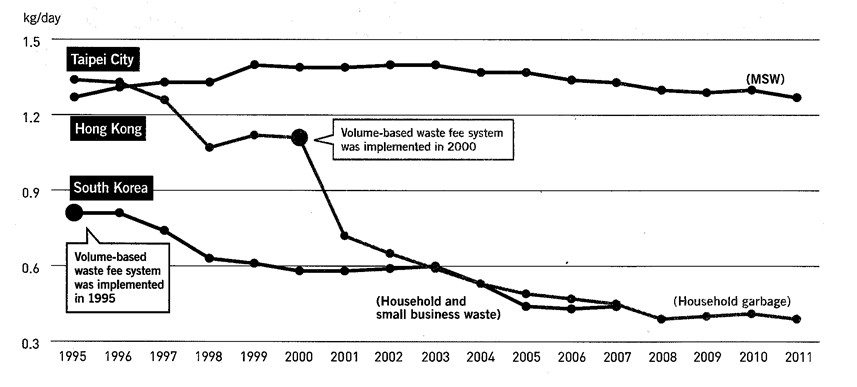
Figure 1: Waste disposal rates per capita and day for Hong Kong, Taipei City and South Korea; the disposal rate of Taipei City is in 1995 slightly higher than in Hong Kong, but this changes in 1996, when Hong Kong's disposal rate surpasses that of Taipei City (Source: HK EB, 2013, p. 8).
It is commendable that the Blue Print emphasizes in its title the concept "resources" over "waste", affirming correctly that "waste" streams "contain a treasure trove of useful resources, much of which can be reused, recycled and recovered" (HK EB, 2013, p. 3), also in agreement with Francis' statement "what is leftover is rich" in 2013 (Francis 2013b). The Blue Print admits "to have relied for too long on landfills to the extent that these are filling up and need to be imminently extended. In future, landfill space must be regarded as one of the city's most precious assets to be more prudently used as a last resort." (HK EB, 2013, p. 7). Hong Kong had to learn also to be more "transparent about the process of recyclables collection and treatment" (Fabian & Lou, 2019, p. 8). The Environmental Protection Department (EPD) admitted in 2019 that the recycling rate in 2010 (52%) "was drastically overstated as they had mistakenly included 'imported waste' (foreign waste awaiting to be exported to China) into their calculations." (Fabian & Lou, 2019, p. 9). But the key point in the Blue Print 2013 is its plan to introduce a WCS for Hong Kong:
One of most forceful tools in waste reduction is MSW charging, which can reduce waste generation by over 20% according to overseas experience. When combined with other ongoing initiatives, we are confident of achieving a 40% reduction in waste disposal by 2022. (HK EB, 2013, p. 18).
The "Polluter Pays Principle" (PPP) and "Producer Responsibility Schemes" (PRSs) are seen as effective tools "in changing the behaviour of businesses to redesign products and packaging to reduce or even eliminate waste." (HK EB, 2013, p. 9). The Waste Reduction Target in the Blue Print is set by 40% reduction in 2022 as compared to 2011:
By 2017, we will have reduced the MSW disposal rate on a per capita basis by 20% from 1.27 kg per day to 1 kg or below. By 2022, we will have further reduced the MSW disposal rate on a per capita basis from 1 kg to 0.8 kg or below, representing a 40% decrease from 2011. (HK EB, 2013, p. 18).
The aim to reach a 40% reduction of MSW from 2011 to 2022 was based on the experience in Seoul and Taipei City in the 1990s, together with synergetic effects of Producer Responsibility Schemes (PRSs), or the Food Wise Campaign, set off in 2013. Following the Principle of the "Waste Hierarchy", the Blue Print favours correctly "Waste Avoidance" over "Recycling". "For instance, using bottled drinks all the time and recycling the used plastic bottles is not as good as avoiding bottled drinks in the first place." (HK EB, 2013, p. 15). This aligns with science and the Zero-Waste-Movements:
It is more efficient and healthier to prevent waste formation in the first place than to treat waste after it has formed. At its core, Zero Waste acknowledges that humans are part of the natural world. It aims for cradle-to-cradle, closed-loop cycling of non-toxic matter that will allow the biosphere in which we are embedded to continue intact into the future. (Robertson, 2014, p. 281–282).
As we will see, the implementation of the Blue Print 2013–2022 turned out to be very challenging, in fact unrealistic. One causal main factor for this is the delay of the implementation of the WCS for about one generation as compared to Taipei City or Seoul. Habits matter, for better or for worse, or any substantial change of engrained throw-away-habits and social systems in Hong Kong turned out to be so far almost unsurmountable.
3. HONG KONG'S WASTE SITUATION 2022–2024
In 2022 the disposal of MSW per person and day was not 0.8 kg or below as planned in the Blue Print 2013–2022, but 1.51 kg. (HK EPD, 2025, p. 11). The planned 40% reduction of daily MSW per capita and day became a nearly 20% increase (!), 1.51 kg in 2022 as compared to 1.27 kg in 2011. The overall waste in 2022 was 15,725 tonnes per day (HK EPD, 2025, p. 7), with 11,129 tonnes of MSW, and with 6,797 daily tonnes being of domestic origin and 4,382 tonnes of commercial and industrial origin. Figure 2 shows the MSW going to landfills in Hong Kong in 2022 according to the different waste types of MSW.
In addition, there were 4,128 tonnes of construction waste per day and 469 tonnes of special waste. The Recovery Rate of MSW in 2022 was 32% and the Disposal Rate of MSW was therefore 68% (HK EPD 2025, p. 27). The Recovery Rate of MSW is the amount of MSW which is recycled or resource-recovered, and does not end up landfilled. As there is now no incineration of MSW in Hong Kong in 2022, the Recovery Rate + Disposal Rate must yield 100%.
How can this massive mismatch of a government policy target be explained, an almost 20% increase instead of a 40% reduction of daily MSW per capita from 2011 to 2022? It does certainly not mean that the Hong Kong Government and society did not do anything since 2013. Valuable efforts to cut MSW at different levels were made. In 2013 the Food Wise Campaign Hong Kong was launched. "The domestic food waste disposal has been reduced by 17% from 0.37 kg per person per day in 2013 to 0.30 kg in 2019." (HK EB, 2021, p. 7). In 2018 and 2019 two important initiatives were launched to reduce or go plastic-free, the Plastic-Free Takeaway, Use Reusable Tableware campaign, and the Plastic-Free Beach, Tableware First, especially to reduce disposable plastic tableware. About 700 local eateries of different sizes collaborate in the campaign.
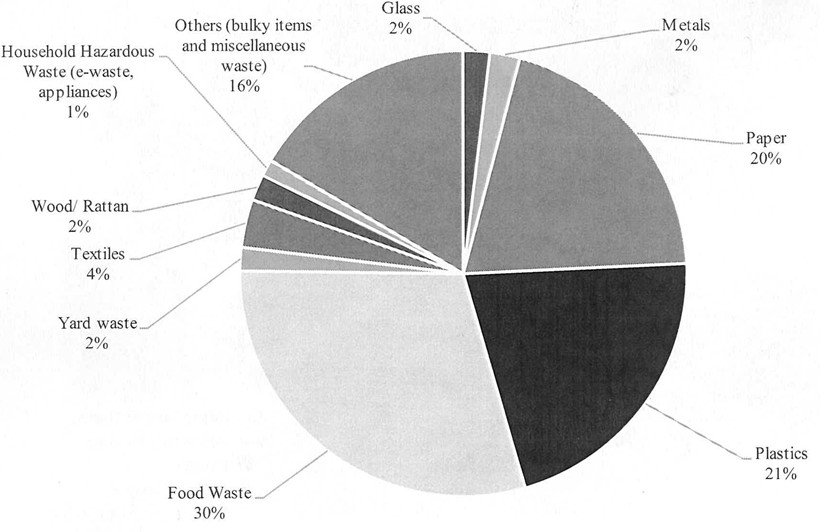
Figure 2: Hong Kong's Landfilled MSW by Waste Type in 2022 (Source: Ancheta, 2025, p. 3, based on HK EPD, 2023).
To boost environmental education, five pilot Community Green Stations were established to promote "public participation in waste reduction and recovery." (HK EB, 2013, p. 22). Several important Producer Responsibility Schemes (PRS) were established. But it seems, all these efforts have been too little, too late in terms of their impact. "Historical MSW policies have largely failed to achieve their objectives, primarily due to implementation difficulties and the absence of economic policies and market instruments specifically designed for MSW management." (Ancheta, 2025, p. 2).
A slow decrease in MSW can be acknowledged, as in 2023 the MSW per capita per day sank to 1.44 kg and in 2024 further to 1.40 kg. (HK EPD, 2025, p. 2). In 2024 the Recovery Rate improved slightly to 34% and thus the Disposal Rate reduced to 66% (HK EPD 2025, p. 27). Food waste in 2024 sank to 3,001 tonnes per day or 29% of MSW, as some food waste is recovered in the new O-Parks. Domestic food waste disposal rate was 0.27 kg/person/day in 2024. (HK EPD, 2025, p. 2). Paper constituted with 23% the second largest part of MSW in 2024, and plastics 18%, that had to be disposed of at landfills, which decreased by 11.1% as compared to 2023. "This reflects the increasing global awareness of 'plastic-free' in recent years and the effectiveness of the Government's active promotion of various related measures, including the implementation of the regulation on disposable plastic products in 2024." (HK EPD, 2025, p. 2).
The overall MSW Recovery Rate in 2024 was 34%, which increased from 33% in 2023. Hong Kong made some good moves based on the "Polluter-Pays-Principle" (PPP), like the Producer Responsibility Schemes (PRS) on plastic shopping bags (PSB), on regulated electrical equipment with the Alba-WEEE Park opening in 2019, and on glass beverage containers, which have been passed by the LegCo between 2012 and 2017. But the difficulty of transforming in a substantial way the engrained habits and social-economic systems due to the absence of consistent market and economic instruments remained the biggest obstacle to move towards a higher level of resource responsibility and sustainable development (Ancheta et al., 2025, p. 2). The change of MSW per capita and day is so far rather marginal than substantial (Figure 3).
4. WASTE BLUE PRINT FOR HONG KONG 2035: "WASTE REDUCTION-RESOURCES CIRCULATION-ZERO LANDFILL" (2021)
The city's Blue Print 2013–22 to curb the waste per capita per day did in fact not work out as planned due to past misjudgements to rely mainly on landfills, in combination with letting the throw-away habits and correlated economic and social systems become firmly established over several decades. In 2021 a new attempt was made in the Waste Blue Print for Hong Kong 2035: 'Waste Reduction - Resources Circulation - Zero Landfill' (HK EB, 2021). Waste Reduction moved up the priority list as the Secretary of the Environment emphasized:
Using less, wasting less and facilitating the circulation of our resources form an integral part of waste management [...] Waste reduction and recycling is our shared responsibility. Yet, driving behavioural and cultural changes is easier said than done. (Wong, 2021, p. 2).
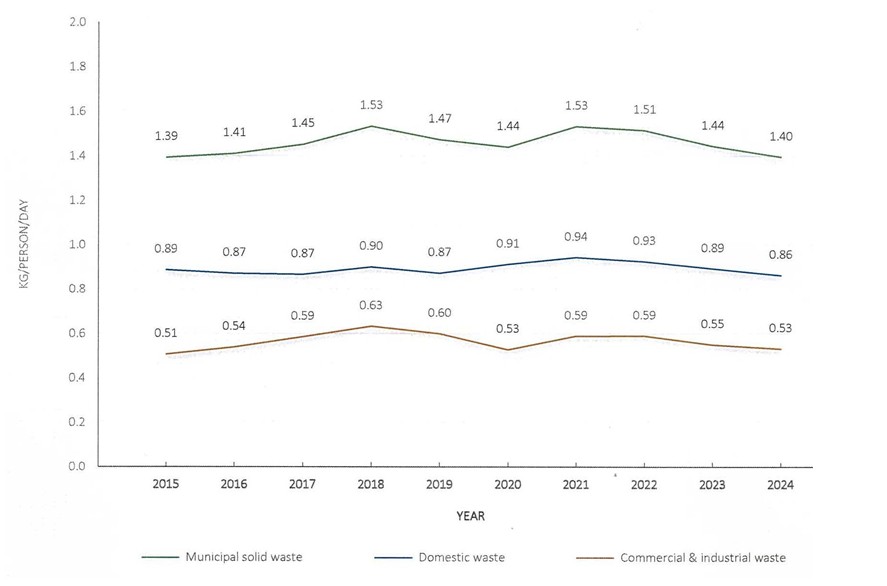
Figure 3: Per capita disposal rates of MSW in Hong Kong from 2015–2024 (Source: HK EPD, 2025, p. 11)
It is indeed extremely challenging to transform an engrained throw-away-culture, habits, and systems. With its Waste Blueprint 2021, Hong Kong started the second attempt to implement the WCS as comprehensive incentive for citizens and businesses to "practise waste reduction and recycling." (Wong, 2021, p. 2):
Implementation of a quantity-based waste charging scheme is indispensable in facilitating resources circulation in Hong Kong. Such system is proven successful in driving social behavioural change in reducing and avoiding waste generation, and providing impetus for waste separation and recycling. (HK EB, 2021, p. 14, emphasis added FG).
The WCS is judged to be the "main driving force" and "cornerstone" (Wong, 2021, p. 2) to reduce the waste of households and businesses. It became the Medium-term Target 1 within the Blue Print 2021 also in view to achieve carbon neutrality by 2050:
By implementing charging for disposal of MSW, to gradually reduce the per capita MSW disposal by 40–45% and increase the recovery rate to about 55%. [...] MSW charging is the cornerstone for promoting waste reduction and recycling. The Government is determined to take the MSW Charging Bill through the legislative process. (HK EB, 2021, p. 17).
Preparatory periods and implementation phases of the WCS were planned for different stakeholders and sectors of the public, but it turned out to be too difficult to implement the WCS effectively in Hong Kong at this late stage, as the people and social systems (including business) have become too accustomed to the "throw-away-culture" for decades. The WCS had to be postponed three times, indefinitely finally in 2024.
But the three main goals of the Waste Blueprint 2021 remain nevertheless recommendable as goals: "Waste Reduction - Resources Circulation - Zero Landfill", with a promotion of low carbon lifestyle and achieving carbon neutrality. These goals result from scientific research (Robertson, 2014) and international experiences. The Second Medium Target in the Waste Blueprint 2021 is To Instill a Green Living Culture in HK through public education campaigns, and the Third Target is Support of the Recycling Trade in HK (Recycling Fund; Green Tech Fund; EcoPark). (HK EB, 2021, p. 17). There are two long-term targets in the Waste Blue Print For Hong Kong 2035: to develop adequate Waste-to-energy facilities, moving away from the reliance on landfills, and the target of Zero-Landfills in 2035. But the question remains, how these targets can be practically achieved given the dominance of the prevailing habits and social systems in Hong Kong.
5. PARTICIPATION OF ALL AND GBA COOPERATION FOR DEEP CARBONISATION AND SUSTAINABLE USE OF RESOURCES
It is commendable that the HK Government in its Climate Action Plan 2021 sets the goal to achieve carbon neutrality before 2050, which requires "deep carbonization involving the whole S.A.R. community with all its stakeholders." "The Government, business sectors, schools and non-governmental organisations must work together and set an example by promoting and encouraging the public to adopt and practise a low-carbon lifestyle." (HK S.A.R. Gov, 2021, p. 23). For developing consistent and coherent local, regional, and national policies and practices, it is necessary to listen to and align policies to global scientific voices, results and data. The experts of the Intergovernmental Panel on Climate Change (IPCC), found out that "21–37% of total greenhouse gas (GHG) emissions are attributable to the food system," originating from "land use, storage, transport, packaging, processing, retail, and consumption." (Mbow et al., 2019, p. 439). As food consumption and food waste takes on a prominent role in the society of Hong Kong, this needs further urgent reflections and inclusion, especially in regard to food waste prevention and its potential for climate change mitigation. "During 2010–2016, global food loss and waste equalled 8–10% of total anthropogenic GHG emissions." (Mbow et al., 2019, p. 440). Prevention of food waste must top the governmental climate mitigation priorities in Hong Kong, which includes also decarbonization of diets:
Demand-side measures (shifting to sustainable healthy diets and reducing food loss/waste) and sustainable agricultural intensification can reduce ecosystem conversion, and methane and nitrous oxide emissions, and free up land for reforestation and ecosystem restoration. (IPCC, 2023, p. 29).
This is of relevance for the Hong Kong society and government, which will be affected by the global emissions of food production and the resulting extreme weather events due to global warming. Food waste prevention must be in future included as top priority in any kind of Climate Action Plan.
It is highly relevant that faith-based communities participate as societal stakeholders in the search for a path to sustainable development, like churches with their schools and parish communities in view of setting good examples, but also other religious communities. Pope Francis' Encyclical Letter Laudato Si' (Francis, 2015) offers an inspirational framework to boost integral human development based on prophetic and contemplative lifestyles (LS 222), calling even for a "bold cultural revolution" to overcome devastating "throw-away-cultures", and win over citizens and societies choose more just and sustainable life-styles, "sensible and profitable ways of reusing, revamping, and recycling" (LS 192). "Reusing something instead of immediately discarding it, when done for the right reasons, can be an act of love which expresses our own dignity" (LS 211). In business this needs leaders and actors to serve the common good of the society. (Deignan Award, 2026). Of relevance is also to deepen the collaboration within the Greater Bay Area, e.g., in the development of "zero waste cities", following the plan of the Central Government 2018, announcing 16 pilot cities and regions for this goal:
"Zero waste city" refers to an urban development model that aims at reducing solid waste generation at source, promoting transformation of waste into resources, reducing landfilling as far as possible, and minimising the environmental impact of solid waste by advocating the principles of innovation, collaboration, green, openness and share use. The Government will strengthen exchanges and training with cities in the Greater Bay Area which are implementing pilot projects for "zero waste city" (such as Shenzhen), and jointly promote management models of advanced green city. (HK EB, 2021, p. 23).
Developing a regional and consistent model of a "Zero-Waste-City" based on "Circular Economy" within the GBA can become a promising inspiration to re-think and re-do current practices, with a "innovative, green and low-carbon development model", like a "plastic-free" society and "adopting an innovative, green and low-carbon development model" (HK EB, 2021, p. 23–24; HK S.A.R. Gov, 2021, p. 31).
CONCLUSION
Hong Kong developed important plans for Resource and Waste Management, but also Climate Action, and made steps and moves to accomplish waste reduction and raising resource responsibility in the S.A.R. But there is still a long way to go to reach the important envisioned goal of Zero-Landfill in 2035, and a truly sustainable form of resource use. One of the biggest obstacles seems to be the over decades developed engrained habits and inert social systems based on a prevailing "throw-away-culture". A deep transformation and decarbonisation need systematic, consistent, and accountable approaches on the local, regional, and national level, with the inclusion of all stakeholders in the society, also religious institutions and churches, rooted in a new eco-social contract. The Encyclical Letter Laudato Si' of Pope Francis can help to build such a new eco-social contract and framework in view of deep decarbonatization and a more responsible use of resources. The promising path of the development of Zero-Waste-Cities as role models in the regional GBA, as well as the transformative tide of the international call for deep decarbonization can help to journey together towards more resource responsible life-styles and sustainable societies.
Franz Gassner, Associate Professor, Faculty of Religious Studies and Philosophy, University of Saint Joseph, Macau.
REFERENCES
- Ancheta, E. D. W., Cambaliza, M. O. L., & Delina, L. L. (2025). Towards Net Zero and a Zero Landfill Future: Leveraging Hong Kong's Municipal Solid Waste Charging Scheme for Sustainable Waste Management and Carbon Neutrality. Journal of Sustainability, Volume 1, Issue 2. https://doi.org/10.55845/jos-2025-128
- Deignan Award. (2026). The Deignan Award for Responsible Entrepreneurship. https://www.deignanaward.org/ (accessed July 5th 2026).
- HK EPD. (2023). Monitoring of Solid Waste in Hong Kong Waste Statistics 2022. https://www.wastereduction.gov.hk/sites/default/files/resources_centre/waste_statistics/msw2022_eng.pdf
- HK EB. (2021). Waste Blue Print for Hong Kong 2035: Waste Reduction-Resources Circulation-Zero Landfill. Hong Kong: Environment Bureau.
- HK S.A.R. Gov. (2021). Hong Kong Special Administrative Region Government. Hong Kong's Climate Action Plan 2050. Hong Kong. https://cnsd.gov.hk/wp-content/uploads/2023/05/Climate-Target-of-HK_en.pdf
- HK EPD. (2025). Environmental Protection Department of Hong Kong. Monitoring of Solid Waste in Hong Kong: Waste Statistics for 2024. Hong Kong: EPD, December 2025.
- HK EB. (2013). Hong Kong Blue Print for Sustainable Use of Resources 2013–2022. Hong Kong.
- Fabian, N., and Lou, LIT. (2019). The Struggle for Sustainable Waste Management in Hong Kong: 1950s–2010s. Worldwide Waste: Journal of Interdisciplinary Studies, 2(1): 10, 1–12. DOI: https://doi.org/10.5334/wwwj.40
- Francis. (2020). Fratelli Tutti. http://www.vatican.va
- Francis. (2015). Encyclical Letter Laudato Si': Care for Our Common Home, Vatican 2015; At the Holy See: https://www.vatican.va/
- Francis. (2013a). Message at the General Audience, June 5th 2013. https://www.vatican.va/
- Francis. (2013b). Pope's Video Message to Recycling Workers of Argentina, Vatican City, December 20th 2013, see: http://www.zenit.org/en/articles/pope-s-video-message-to-recycling-workers-of-argentina
- IPCC. (2023). Summary for Policymakers. In: Climate Change 2023: Synthesis Report. Contribution of Working Groups I, II and III to the Sixth Assessment Report of the Intergovernmental Panel on Climate Change [Core Writing Team, H. Lee and J. Romero (eds.)]. IPCC: Geneva, Switzerland, pp. 1–34, doi: 10.59327/IPCC/AR6-9789291691647.001
- Laudato Si' Movement. (2026). https://laudatosimovement.org/
- Mbow, C., C. Rosenzweig, L.G. Barioni, T.G. Benton, M. Herrero, M. Krishnapillai, E. Liwenga, P. Pradhan, M.G. Rivera-Ferre, T. Sapkota, F.N. Tubiello, Y. Xu. (2019). Food Security. In Climate Change and Land: an IPCC special report on climate change, desertification, land degradation, sustainable land management, food security, and greenhouse gas fluxes in terrestrial ecosystems. [P.R. Shukla, J. Skea, E. Calvo Buendia, V. Masson-Delmotte, H.-O. Pörtner, D.C. Roberts, P. Zhai, R. Slade, S. Connors, R. van Diemen, M. Ferrat, E. Haughey, S. Luz, S. Neogi, M. Pathak, J. Petzold, J. Portugal Pereira, P. Vyas, E. Huntley, K. Kissick, M. Belkacemi, J. Malley, (eds.)]. Geneva: IPCC. https://doi.org/10.1017/9781009157988.007
- Robertson, Margaret. (2014). Sustainability: Principles and Practice, London-New York.
- Rotondi, Valentina, & Santori, Paolo. (2023). Rethinking Economics Starting from the Commons: Towards an Economics of Francesco (Contributions to Economics). Cham, Swiss: Springer, 2023.
- The Macau Manifesto. (2020). The Macau Manifesto for The Economy of Francesco, Assisi, November 2020. Website: https://www.deignanaward.org/
- Tornielli, Andrea, & Galeazii, Giacomo. (2015). This Economy Kills: Pope Francis on Capitalism and Social Justice. Collegeville, Minnesota, 2015.
- Turkson, Cardinal Peter. (2019). Message of the Prefect of the Dicastery for Promoting Integral Human Development to the scientific community on the occasion of the fourth anniversary of Pope Francis' Encyclical Laudato si', Rome, 24th May 2019. At the Holy See: www.vatican.va
- Wong, Kam-sing. (2021). Preface. In: Environment Bureau Hong Kong. Waste Blue Print for Hong Kong 2035: Waste Reduction-Resources Circulation-Zero Landfill. Hong Kong: Environment Bureau.
- Wong, Kam-sing. (2013). Preface. In: Environment Bureau. 2013. Hong Kong Blue Print for Sustainable Use of Resources 2013–2022. Hong Kong: Environment Bureau, 2013.
- Zero Waste Europe. (2015). Pope Francis Embraces Zero Waste. Zero Waste Europe News, June 18th 2015. https://zerowasteeurope.eu/
Click here to view the PDF version